D. Samsonov and J. Goree
Instabilities in a Dusty Plasma with Ion Drag and Ionization
Physical Review E Vol. 59, pp. 1047-1058, 1999
reprint
We recorded the optical glow and the laser light scattering (LLS) simultaneously,
using two different video cameras.
The two videotapes (glow and LLS) were recorded with common timecodes. We used
this timecode to select still images for the paper so that the glow and the
LLS pictures are shown at exactly the same time. The MPEG movies shown here,
however, do not start at precisely the same video frame. They start at approximately
the same time, with an accuracy of ~ 2 sec.
Movies:
Click here for movies and explanation orresponding to the paper :
T. Flanagan and J. Goree
Dust release from surfaces exposed to plasma
Physics of Plasmas, Vol.13, article no. 123504, pp. 1-11, 2006
reprint
Movies from this paper:
V. Nosenko and J. Goree
Shear Flows and Shear Viscosity in a Two-Dimensional Yukawa System (Dusty Plasma)
Physical Review Letters, Vol. 93, pp. 155004-1 – 155004-4, 2004
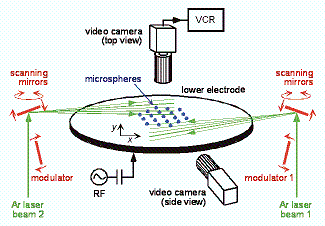
Sketch of apparatus setup:
In this experiment, a 2D suspension of microspheres was levitated. Without any manipulation, they self-organized in a traingular lattice. We then applied shear stress by applying two stripes of laser light. The laser light applies a 'radiation pressure force', pushing the microspheres. The two stripes are parallel, and aligned in the 'x direction.' In the movies, the upper laser beam pushes particles to the right, while the lower one pushes them to the left. This resembles Couette flow, except that there is no solid boundary involved.
Movies:
Particle motion without any applied shear 2.8 MB avi movie
Particle motion under medium shear (0.82 W laser power) 2.8 MB avi movie
Particle motion under high shear (3.41 W laser power) 3.2 MB avi movie
Movies from this paper :
Bin Liu, K. Avinash and J. Goree
Transverse Optical Mode in a One-Dimensional Chain
Physical Review Letters, Vol. 91, 255003, 2003
reprint
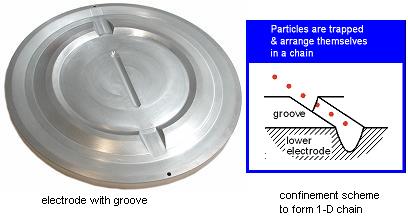
Apparatus setup, for confining a 1D chain by levitating charged particles in
an electric sheath above a grooved electrode:
Movies:
Natural motion, without any laser manipulation 15 MB avi movie
Wave motion excited by laser manipulation modulated at 3 Hz, as shown in sketch above 10 MB avi movie
