




John A. Goree - Banner
  Photos of our labs
home
research
research group
teaching
vita-pdf
vita-html
online reprints
prospective students
prospective postdocs
talks
[room 555 Van Allen Hall] [room 626 Van Allen Hall] [room 501 Van Allen Hall]


555 Van Allen Hall:

This room is 1000 square feet.


Photos taken May 2002:


Shown below are three photos of room 555.


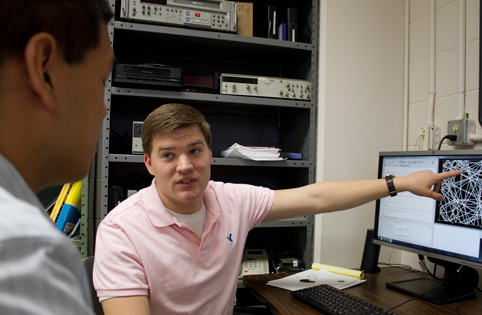
In the photo below are (from left to right): Bin Liu, Vova Nosenko, and John Goree


Photos taken May 1999:


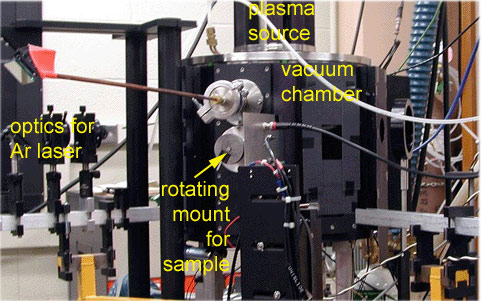
Strongly-coupled dusty plasma experiments are conducted in a GEC Reference Cell, which has been modified especially for this purpose. Here is a photo of the back of this setup. The actual chamber is in the center of the image, but it is partly obscured by various mechanical, vacuum, and electrical accessories. At the left you see a turbopump, and above the chamber you see a framework that is used to hold a white camera near the top of the image. The black vertical rectangular item in the foreground to the left is a motorized mount for the transmission laser optics, which include a laser, a telescope, and a high-speed rotating mirror. These optics produce a highly-uniform laser sheet with a thickness of about 200 microns. We tilt the laser sheet to bring it into alignment with crystalline layers in the sample region inside the vacuum chamber. The stepping motor that positions these optics can be operated in conjunction with the stepping motor that moves the camera at top, thereby keeping the plane of illumination in focus as it is moved through the sample volume.

-----


One thing we do while operating the experiment is measure current and voltage waveforms of the powered electrode using a digital oscilloscope, as Rick Quinn is doing here. A function generator, located below the oscilloscope, is the source of the waveform which is amplified to drive the lower electrode and thereby sustain the plasma. On the left you see a camera used to image particles in the GEC chamber, which is located to the left of this photo. The camera is fitted with a Nikon micro lens and a bandpass interference filter to admit only the wavelength of the laser light used to illuminate particles. In the background you can see video monitors and VCR's, which are used to record images of the particles.

-----


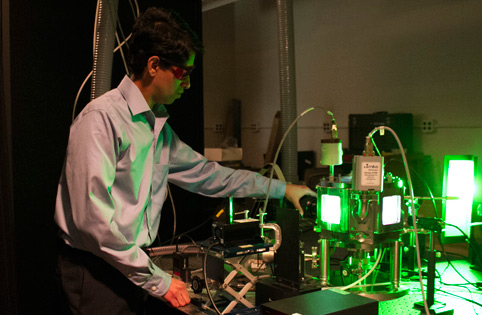
Another vacuum chamber is used for growing particles in-situ by sputtering the electrodes of a parallel-plate rf discharge. The vacuum chamber is black to reduce scattered light. In the back of the room is a window which is equipped with a black-out shade so that we can darken the room. In the past, we used this same chamber for laser-induced fluorescence experiments with magnetron and multidipole plasma sources. In its present application, particles in the plasma are imaged by laser scattering, where an argon-laser beam is delivered to the chamber by the mirrors that Dmitry Samsonov adjusts in this photo:

-----


Here's a view of the other side of the black vacuum chamber. The black parts in the foreground are the transmission optics to point the argon laser and to focus it into a sheet of light. In the background, Rick Quinn is taking some data.

-----


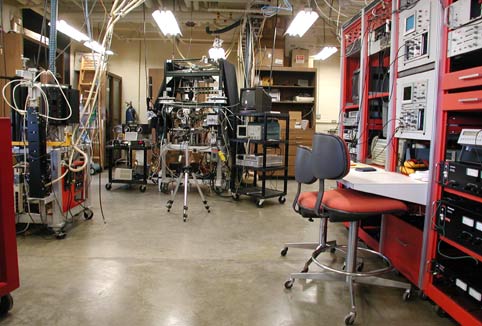
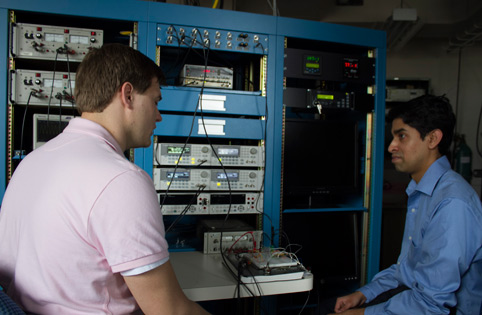
Experiments with synchronized timing of the imaging use function generators and pulse generators, which are located in our 5 instrument racks, as shown here with Dmitry Samsonov:

-----


A significant part of our effort is image analysis and other data processing tasks. We've done quite a lot of code development. This is done using UNIX workstations and PC's.


-----

Here's an avi movie providing a 360-degree panaroma of room 555 Van Allen Hall. Recorded May 2002 (13 MB download):

555_movie_still


626 Van Allen Hall:

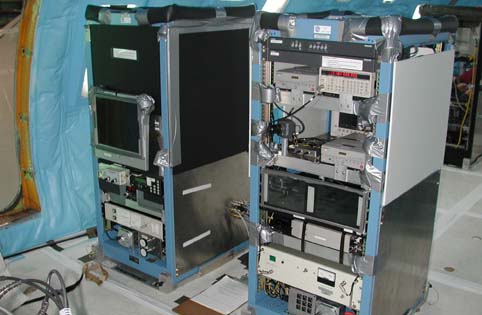
  • This lab room has hardware designed for flying on NASA's KC-135 parabolic flights. There are 2+ racks of equipment that fly in the plane. The mechanical hardware was designed by engineer Allen Cooper, shown below. Photo 2002.


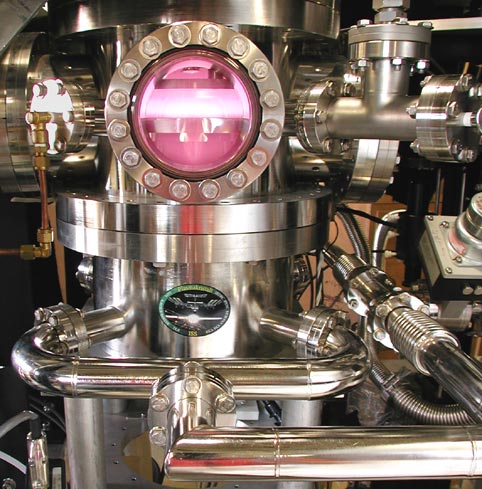
    Shown below is the plasma chamber and some of the optics in the KC-135 setup. Photo 2002.


Shown below is one of the racks, ready for flight, with all the instruments strapped down so that they can sustain 9 g's of forward acceleration. Photo 2002


501 Van Allen Hall:

  • This room is 700 square feet. It is being renovated in 2002-2003. It will be a new lab, to replace room 626. (no photos available yet)

gradient bar